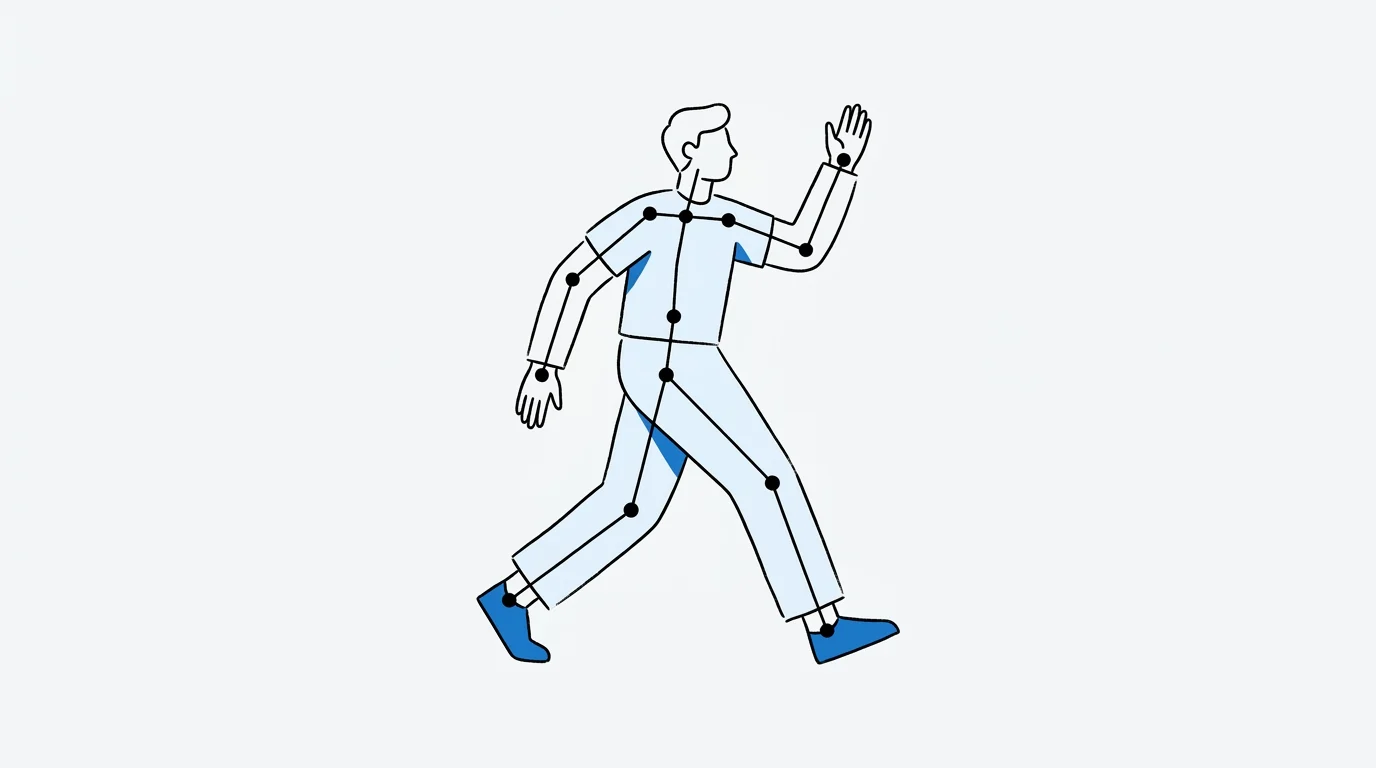
Open-source pose estimation models such as ViTPose, RTMPose, and YOLO-Pose have become remarkably capable. Today, model selection is rarely the biggest challenge. Annotation quality is.
Many pose estimation systems underperform not because of the model, but because the training data contains inconsistent or inaccurate keypoint labels. A misplaced elbow or a poorly labeled occluded wrist becomes noise the model can never fully overcome.
The Hidden Bottleneck: Keypoint Consistency
Pose estimation is evaluated with Object Keypoint Similarity (OKS), which measures how closely predicted keypoints match the ground truth. If human annotators cannot consistently agree on keypoint placement, your model reaches an accuracy ceiling regardless of architecture or compute.
More training won’t fix inconsistent labels. Better annotation will.
Where Annotation Gets Difficult
The standard 17-keypoint COCO format works well for general use, but production applications quickly become more demanding:
- Sports analytics: custom keypoints for equipment such as rackets or barbells
- AR/VR and sign language: dense hand keypoints with heavy self-occlusion
- Healthcare: medical-grade accuracy for rehabilitation and motion analysis
- Driver monitoring: robust labeling across sunglasses, facial hair, poor lighting, and partially visible faces
Each use case requires different annotation rules, not just different models.
What High-Performing Teams Do Differently
- Define the keypoint schema before annotation begins
- Document occlusion rules so every annotator handles hidden joints the same way
- Measure annotation quality with OKS and inter-annotator agreement, not visual inspection alone
- Match the annotation strategy to the model pipeline (top-down vs. bottom-up)
The Takeaway
Today’s pose estimation models are already strong. The real competitive advantage lies in high-quality, consistent annotation pipelines. Your model learns exactly what your annotators teach it.
About Smart Annotahub
Smart Annotahub is a managed data annotation company based in Ha Noi, Viet Nam. Our in-house annotators, QA leads and project managers turn raw image, video, 3D, geospatial, text and audio data into training-ready datasets for teams building computer vision, robotics and language AI. Every project starts with a free pilot, runs on your guidelines and tools, and ships with multi-stage quality checks.
Our Services
Frequently Asked Questions
How does the free pilot work?
Send us a sample of your data and your guidelines. We annotate it at no cost, report accuracy and turnaround, and return a precise quote, usually within a few working days.
How do you ensure annotation quality?
Every batch passes annotator self-checks, peer review and a dedicated QA lead. We agree accuracy targets up front and share QA reports with each delivery.
Can you work in our annotation tool?
Yes. Our team works in your platform or ours and delivers in the formats your pipeline expects, such as COCO, YOLO, Pascal VOC or custom JSON.
How is my data kept secure?
All work is done by our in-house team under NDA, with role-based access and no data leaving approved environments. See our Data Privacy Notice for details.
How is pricing calculated?
Per object, per hour or per project, depending on the task. See Pricing for reference rates, or request a pilot for an exact quote.
Want to see the difference on your own data?
Request Free Pilot