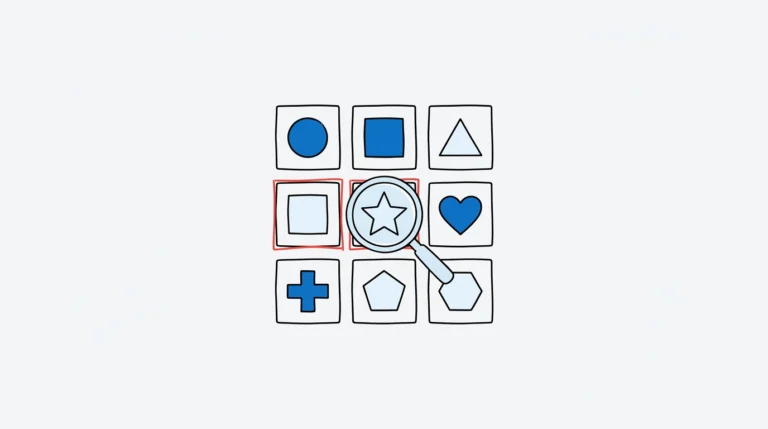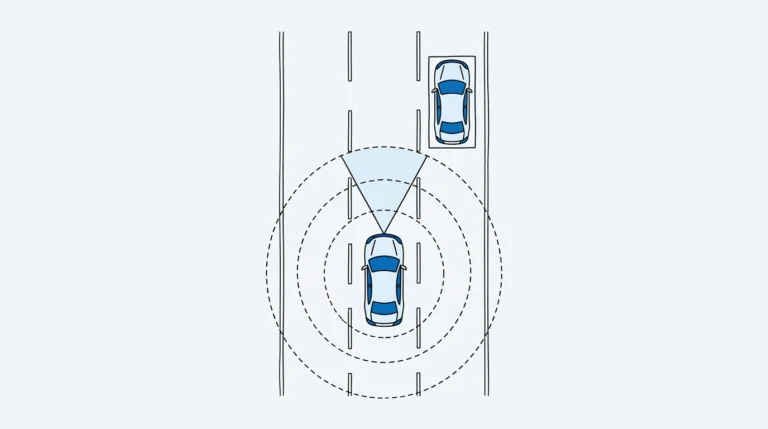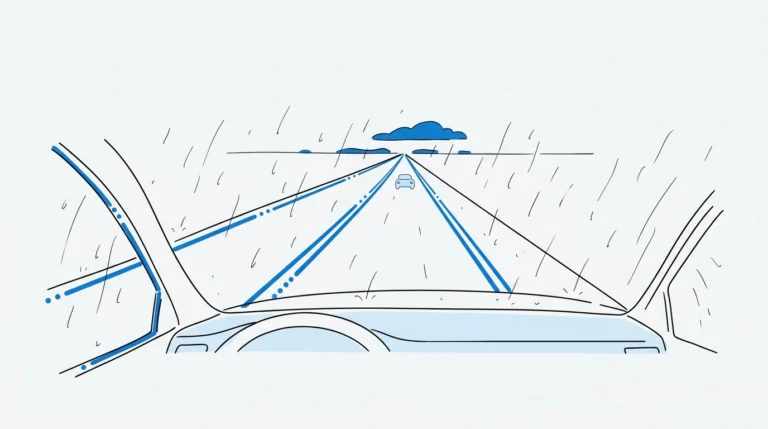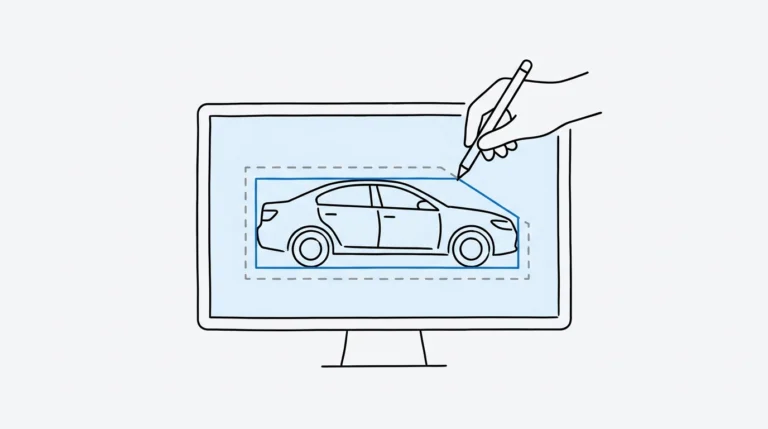
Segmentation is the most detailed form of image annotation, and the most expensive. Picking the wrong type either leaves your model without the information it needs or pays for detail it will never use.
Things and Stuff
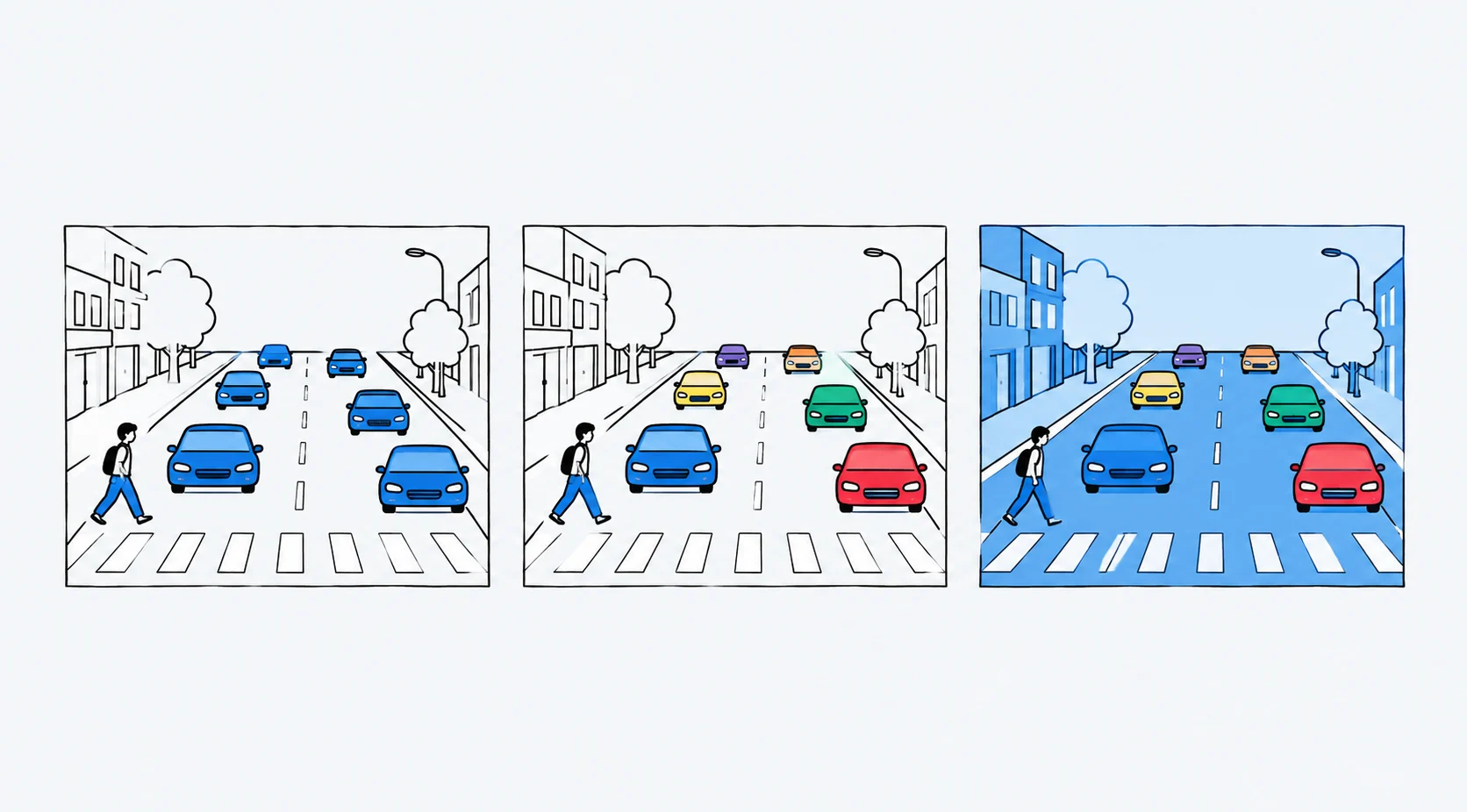
Computer vision researchers split scenes into two groups. Things are countable objects: cars, people, boxes. Stuff is amorphous background: road, sky, grass, water. The three segmentation types differ in how they treat each group.
Semantic Segmentation
Every pixel gets a class label. All cars share the label “car”, so the model knows where cars are but not how many there are. It suits tasks driven by regions: drivable area, land cover, crop fields and surface defects.
Instance Segmentation
Each countable object gets its own mask and ID, so three pedestrians become three separate masks. Background stuff is usually ignored, and in formats such as COCO, instance masks may overlap. It suits counting, tracking, picking and any task where individual objects matter.
Panoptic Segmentation
Introduced by Kirillov et al., panoptic segmentation combines both: every pixel gets exactly one class label, and pixels on things also get an instance ID. Masks cannot overlap, so annotators must decide which object owns each boundary pixel. The result is a complete map of the scene.
Choosing the Right Type
- Need regions only? Semantic segmentation is fastest and cheapest.
- Need to count or track objects? Instance segmentation, possibly only for the classes that matter.
- Need full scene understanding for driving, mapping or robotics? Panoptic segmentation.
- Not sure? Label a pilot batch panoptically. Semantic and instance labels can be derived from panoptic data, but not the other way round.
Annotation Cost Drivers
Cost scales with boundary complexity, the number of instances per image and the rules for occlusion. Clear guidance on overlaps, thin structures such as poles and wires, and a minimum object size keeps cost and inconsistency down.
About Smart Annotahub
Smart Annotahub is a managed data annotation company based in Ha Noi, Viet Nam. Our in-house annotators, QA leads and project managers turn raw image, video, 3D, geospatial, text and audio data into training-ready datasets for teams building computer vision, robotics and language AI. Every project starts with a free pilot, runs on your guidelines and tools, and ships with multi-stage quality checks.
Our Services
Frequently Asked Questions
How does the free pilot work?
Send us a sample of your data and your guidelines. We annotate it at no cost, report accuracy and turnaround, and return a precise quote, usually within a few working days.
How do you ensure annotation quality?
Every batch passes annotator self-checks, peer review and a dedicated QA lead. We agree accuracy targets up front and share QA reports with each delivery.
Can you work in our annotation tool?
Yes. Our team works in your platform or ours and delivers in the formats your pipeline expects, such as COCO, YOLO, Pascal VOC or custom JSON.
How is my data kept secure?
All work is done by our in-house team under NDA, with role-based access and no data leaving approved environments. See our Data Privacy Notice for details.
How is pricing calculated?
Per object, per hour or per project, depending on the task. See Pricing for reference rates, or request a pilot for an exact quote.
Want to see the difference on your own data?
Request Free Pilot